
.png)
 1 day ago
1
1 day ago
1
ARTICLE AD BOX
Artists gather at NAPA to celebrate Master Ghulam Haider's enduring influence on South Asian music
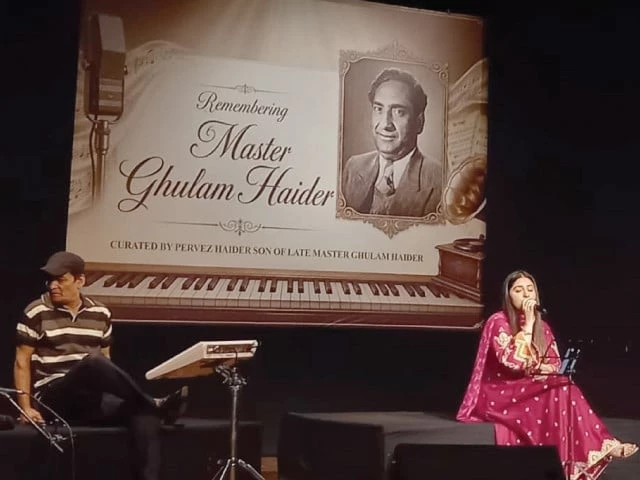
Singer Ayat Sheikh performs a song composed by Master Ghulam Haider at NAPA. Photo: Express
KARACHI:
Artists from Karachi, Lahore, Islamabad and other cities came together at the National Academy of Performing Arts (NAPA) in Karachi to celebrate and honour the legacy of legendary composer Master Ghulam Haider, a man regarded as one of the pioneers of South Asian film music. The special tribute event was organised by the Mauseeqar-e-Azam Memorial Society and curated by Pervez Haider, son of the late maestro. Among the performers was Islamabad-based singer Gulshan Jahan, who captivated the audience with renditions of songs associated with the golden era of music. Master Ghulam Haider is remembered as one of the most influential composers in the history of the Subcontinent. Historians credit him with revolutionising film music and helping launch the careers of some of South Asia's most iconic voices, including Noor Jehan, Shamshad Begum and Lata Mangeshkar. His compositions continue to inspire musicians and music lovers decades after they were first created. "Master Ghulam Haider's songs are very difficult to sing. I am grateful to NAPA and especially to his son, Pervez Haider, for giving me the opportunity to pay tribute to such a great legend," said Gulshan Jahan. Gulshan told the audience that performing songs composed by Master Ghulam Haider was both an honour and a challenge. "When I searched for information about him online, I was amazed by the wealth of material available. I had no idea he was such a great composer." The singer also spoke about her excitement at performing in Karachi for the first time. "I was very excited before coming to Karachi. This was my first performance here and I loved the experience." Gulshan Jahan admitted she was surprised by the audience's response, particularly their enthusiasm for Punjabi songs. The evening also featured live performances of several classic melodies, drawing applause from the audience and highlighting the enduring appeal of Master Ghulam Haider's music. For Pervez Haider, the tribute was not only a cultural event but also the culmination of months of hard work and decades of dedication to preserving his father's legacy. Speaking to The Express Tribune, he said he had spent nearly three months in Karachi preparing for the event and was pleased with the successful conclusion of the programme. "The support of the media and all those who stood by me played a huge role in making this tribute successful," he said. Pervez has been organising commemorative events across Pakistan to ensure that younger generations remain connected to the contributions of the maestro. "Master Sahib was a great man. I am simply a worker trying to keep his legacy alive. Whatever I am today is because of my father and the blessings of Allah." The evening was more than a tribute concert; it was a celebration of a musical legacy that helped shape the sound of South Asian cinema. Decades after his passing, his compositions remain alive in the voices of singers and in the memories of music lovers, a testament to the enduring power of his artistry. The tribute also served as a reminder of the extraordinary career that made Master Ghulam Haider one of the most influential figures in South Asian music. Born in 1908 in Hyderabad, Sindh, Master Ghulam Haider worked both in India and later in Pakistan after the Partition in 1947. He changed the face of film songs by combining popular raagas with the verve and rhythm of Punjabi music and also helped raise the status of film music directors. He got his first major breakthrough with DM Pancholi's Punjabi film, 'Gul-e-Bakavali' (1939), starring Noor Jehan. This was followed by the film 'Yamla Jat' (1940). Before that, AR Kardar had allowed him to compose music for the 1935 film, 'Swarg Ki Seerhi'. His first major hit came with 'Khazanchi' in 1941. In particular, the song 'Sawan Ke Nazare Hain', sung by Shamshad Begum, caused a revolution in music composition. In Mumbai - then Bombay - he composed music for 'Humayun' (1945) and 'Majboor' (1948), the latter being the first breakthrough film for Lata Mangeshkar. After the Independence of Pakistan in 1947, Master Ghulam Haider returned to Lahore, and his first Pakistani film was 'Shahida' (1949). He composed music for many other Pakistani films, including 'Beqarar' (1950), 'Akeli' (1951) and 'Bheegi Palkein' (1952). During his illustrious career, Master Ghulam Haider created numerous unforgettable songs that shaped the history of South Asian music. His work in films such as 'Khazanchi' (1941), 'Khandan' (1942), 'Poonji' (1943), 'Humayun' (1945) and 'Shaheed' (1948) transformed the subcontinent's musical landscape. Master Ghulam Haider passed away on November 9, 1953, due to throat cancer at the age of 45, just a few days after the release of the Pakistani film 'Gulnar'. He was posthumously awarded the Tamgha-i-Imtiaz in 2011 and the Pride of Performance in 2018 by the government of Pakistan.







 English (US) ·