
.png)
 8 hours ago
2
8 hours ago
2
ARTICLE AD BOX
Israel is most exposed to global boycotts, facing sanctions on officials and institutions worldwide
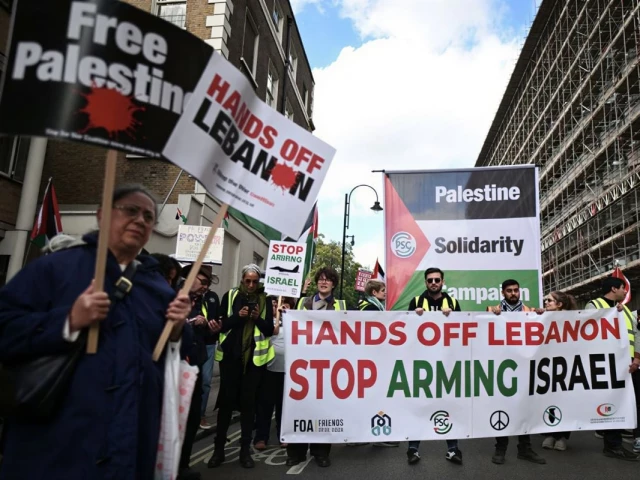
Pro-Palestinian supporters wave flags and hold placards as they pass through central London, UK. PHOTO: AFP
Israel has become the country most exposed to boycotts worldwide, facing a sweeping wave of international sanctions targeting government officials, occupiers and official institutions, the daily Yedioth Ahronoth said on Thursday. Under the headline “How Israel became the most boycotted nation in the world”, the newspaper said Israel had faced “a tsunami of international sanctions targeting Israeli government officials, occupiers and institutions, escalating pressure from multiple countries and long-standing pro-BDS organisations”. It said France recently barred Israeli Finance Minister Bezalel Smotrich from entering the country, after previously imposing a similar ban on National Security Minister Itamar Ben-Gvir. According to the newspaper, the French move came in response to the two ministers’ “active promotion of West Bank annexation, new settlements and policies perceived as undermining the Palestinian Authority”. The United Nations considers the West Bank, including East Jerusalem, to be occupied Palestinian territory, and its annexation to Israel would effectively eliminate the possibility of establishing an independent Palestinian state envisioned in international resolutions. Growing momentum Yedioth Ahronoth said until October 7, 2023, Israel had managed to limit the impact of boycott, divestment and sanctions (BDS) campaigns. Read More: How US and Israel are the biggest losers of this war “Economic sanctions had little effect because Israel’s strong economy discouraged divestment, while academic and cultural boycotts were largely symbolic,” it added. "However, the phenomenon has intensified, with BDS achieving successes in multiple fields,” the daily said. “The movement has damaged Israel’s reputation internationally, evident in public opinion surveys showing growing negative perceptions.” The report cited several examples, including artists refusing to perform in Israel, authors refusing Hebrew translations of their work and campaigns removing Israel from events like Eurovision or FIFA competitions. It also pointed to growing efforts to withdraw foreign investments, “including the Norwegian sovereign wealth fund divesting from Israeli companies”. “The UN Human Rights Council blacklist targets Israeli and international companies operating beyond the Green Line,” the paper said, referring to illegal settlements in the occupied West Bank and East Jerusalem. “Reports and videos from the West Bank showing occupiers engaging in violent behaviour against Palestinians and property damage have further fuelled the sanctions,” the report said. “Public statements and actions by ministers, especially Ben-Gvir’s widely circulated video humiliating flotilla participants bound for Gaza, drew condemnation from multiple countries as crossing a red line.” Western sanctions Referring to France’s decision to bar Smotrich and Ben-Gvir, the newspaper said Paris had joined Ireland, the United Kingdom, Canada, Australia, New Zealand and Norway in restricting entry for Israeli ministers. Also Read: Amnesty: Israel engaged in 'ethnic cleansing' “France, the United Kingdom, Canada, Australia, New Zealand and Norway have coordinated sanctions against occupiers and organisations promoting violence in the West Bank,” it said. France has also restricted the entry of four illegal settlement leaders and 21 occupiers, according to the report. The UK launched “a plan of action” targeting networks that finance and support occupiers’ attacks, “urging businesses to avoid operations in West Bank settlements”. “Canada imposed entry bans and financial restrictions on two citizens and five organisations, while Australia sanctioned three citizens and six outposts,” the newspaper said. New Zealand also barred three Israelis, adding them to a blacklist of 35 individuals that includes Ben-Gvir, Smotrich and illegal settlement figures such as Daniela Weiss, Ze’ev Haber, Elisha Yered, Noam Federman, Baruch Marzel and Bentzi Gopstein. “In addition to sanctions, France has opened investigations into alleged torture and war crimes linked to the flotilla incident and Italy announced an inquiry into Ben-Gvir for humiliating Italian civilians,” the report added. “EU discussions are ongoing regarding personal sanctions against Israeli ministers,” the paper said. “Germany reportedly opposes measures against Smotrich but may support restrictions on Ben-Gvir, though a Czech veto could prevent action,” it added. Analysts cited by the newspaper said broad economic sanctions against Israel “are unlikely in the short term, but personal sanctions against ministers are expected to remain under consideration”. They argued that Prime Minister Benjamin Netanyahu’s government has failed to effectively respond to these developments, mobilise friendly countries or engage with global Jewish communities in confronting the boycott movement. Netanyahu has been wanted by the International Criminal Court since 2024 on charges of war crimes and crimes against humanity committed against Palestinians in Gaza, where nearly 73,000 people have been killed and over 173,000 others have been injured in a genocidal war since October 2023. Israel is also facing a case before the International Court of Justice brought by South Africa and supported by several countries, accusing it of committing genocide in the Palestinian enclave.





 English (US) ·