
.png)
 8 hours ago
1
8 hours ago
1
ARTICLE AD BOX
Now Pakistan must graduate from GSP+ and negotiate lasting market access
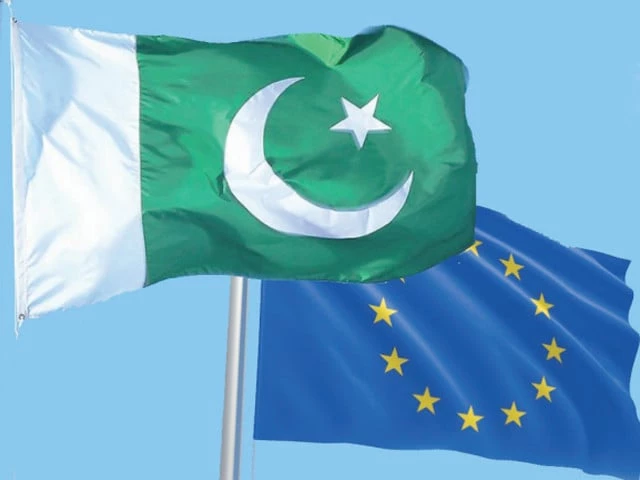
TIME TO ACT: If other developing economies are securing comprehensive trade agreements and integrating more deeply into global markets, Pakistan should ask why it remains so dependent on unilateral preferences. PHOTO: AFP
ISLAMABAD:
The European Union's latest assessment of Pakistan's performance under the GSP+ preferential trade scheme presents a mixed picture. There is encouraging progress, but also areas of serious concern. The report is neither a recommendation to withdraw Pakistan's GSP+ status nor a clean bill of health. Among the positive developments, the report highlights stronger human rights institutions, the establishment of a National Commission for Minorities, the narrowing of the scope of the death penalty, the continued de facto moratorium on executions, implementation of the Anti-Torture Act, and measures to combat gender-based violence. At the same time, it identifies significant concerns relating to political rights, judicial independence, enforced disappearances, freedom of expression, and media freedom. It also raises questions about the application of laws concerning blasphemy, counterterrorism, and cybercrime. The message is clear. Ratifying international conventions and passing legislation are important first steps, but they must be matched by effective implementation. This becomes even more important as the EU's new GSP regulation comes into force on January 1, 2027, introducing stronger sustainability and governance requirements for beneficiary countries. GSP+ has been highly beneficial for Pakistan. It provides preferential access to the European market without requiring reciprocal tariff concessions to European exporters. In 2024 alone, Pakistan exported goods worth around €7.5 billion under the scheme, with tariff preferences estimated at approximately €732 million. Nevertheless, GSP+ should be viewed as a transitional arrangement rather than a permanent framework for Pakistan's trade relations. There are five reasons. First, the preferences are conditional. Pakistan remains under continuous monitoring, and the concessions can be suspended if the EU concludes that the country has failed to meet its commitments. The latest report illustrates the nature of this ongoing scrutiny. Second, GSP+ is a unilateral preference scheme, meaning that the EU can exclude any product if it feels that it has become sufficiently competitive. Unlike a free trade agreement, it provides no permanent or contractual guarantee of market access. Pakistan's recent experience with ethanol illustrates this vulnerability. Third, GSP+ is intended primarily for low-income and lower-middle-income countries that are economically vulnerable. Pakistan should aspire to become a middle-income country, as several other countries such as Jordan, Vietnam and even Sri Lanka have recently done, rather than remain a GSP beneficiary. Fourth, the new GSP+ scheme, effective January 2027, introduces stronger implementation and enforcement mechanisms, including linking trade preferences to cooperation with the EU on the readmission of nationals. Pakistan will soon realise that it cannot get away with lip service to the GSP conditions. Finally, studies show that countries that rely heavily on trade preferences tend to channel domestic resources into products that enjoy the largest tariff margins, such as textiles and clothing. This discourages export diversification, leaving such countries overly dependent on a narrow range of products. Many of Pakistan's competitors are already moving in this direction. India and Indonesia have concluded negotiations on comprehensive trade agreements with the EU, while Thailand, Malaysia, and the Philippines are pursuing similar negotiations. The EU-Mercosur agreement has also entered provisional application. These countries increasingly view reciprocal trade agreements as a more predictable and durable foundation for trade and investment. Until recently, Pakistan was poorly positioned to pursue such agreements. Its highly protectionist tariff regime, characterised by high customs duties, regulatory duties and additional customs duties, made it difficult to negotiate meaningful free trade agreements. Pakistan had little choice but to focus on securing preferential access to foreign markets while continuing to shield its own domestic market from competition. That situation is now beginning to change. The National Tariff Policy 2025-30 and the ongoing tariff rationalisation programme provide an opportunity to build a more open and competitive economy. As Pakistan's tariff rates move closer to South and East Asian levels, it should become much easier to negotiate meaningful free trade agreements that offer genuine market access, rather than the largely symbolic agreements it has today. The question Pakistan should now ask is not how long it can remain under GSP+, but how quickly it can graduate from it. Least developed countries may have little alternative but to rely on unilateral preference schemes. A country of Pakistan's size, capability, and economic potential should set its sights higher. If other developing economies are securing comprehensive trade agreements and integrating more deeply into global markets, Pakistan should ask why it remains so dependent on unilateral preferences. The answer cannot simply be that opening domestic markets is difficult. The purpose of tariff reform is precisely to prepare Pakistan to compete successfully in a more open trading environment. GSP+ should therefore serve as a bridge to a comprehensive free trade agreement, not a substitute for one. The writer is a trade arbitrator and former ambassador and permanent representative of Pakistan to the WTO





 English (US) ·