
.png)
 9 hours ago
2
9 hours ago
2
ARTICLE AD BOX
Says India’s approach in Afghanistan driven by a single objective, which he described as 'destabilising Pakistan'
Web Desk
June 09, 2026
9 min read
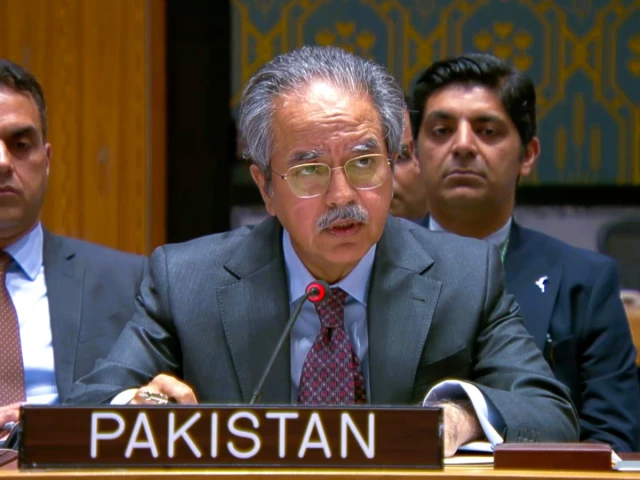
Pakistan’s Permanent Representative to the United Nations, Asim Iftikhar Ahmad addressing the United Nation Security Council. PHOTO: X
Pakistan called on Afghanistan’s Taliban authorities to take “verifiable and non-reversible action” against terrorist groups operating from Afghan territory, as its envoy to the United Nations accused India of backing terrorists and using Afghanistan to destabilise Pakistan during a UN Security Council debate on Monday. Addressing the UN Security Council, Pakistan’s Permanent Representative to the United Nations, Asim Iftikhar Ahmad, said Pakistan had consistently supported Afghanistan through humanitarian relief, political engagement and efforts to strengthen bilateral trade. Pakistan’s envoy said that in support of what he described as “our Afghan brethren,” Islamabad had taken “numerous steps to support Afghanistan, including humanitarian relief efforts, political engagement, and providing incentives to boost bilateral trade.” It was expected after the end of the civil war that the Taliban would evolve into a responsible governing authority. “It was anticipated that the Taliban would take positive steps to transform into a responsible governing authority by adhering to their international obligations and commitments,” the envoy said. Today I delivered Pakistan's statement during the UN Security Council meeting on the situation in Afghanistan.
I highlighted the following points:
➡️ To help our Afghan brethren, Pakistan took numerous steps to support Afghanistan, including humanitarian relief efforts,… pic.twitter.com/sWSnHYX5ca However, Pakistan’s envoy warned that terrorism remained deeply entrenched in Afghanistan, with implications extending beyond its borders. “For decades, terrorism has been a major problem in Afghanistan, with implications not just for Afghanistan, but the immediate neighbourhood and beyond,” he said. Pakistan’s envoy said the expectation was that the Taliban would take “concrete and verifiable actions” against terrorist groups, including the TTP, BLA and its Majeed Brigade, ISIL-K, ETIM and affiliated networks operating from Afghan territory. “It was our expectation that the Taliban would take concrete and verifiable actions against terrorist groups such as the TTP, BLA and its Majeed Brigade, ISIL-K, ETIM and their affiliates that are operating with impunity on Afghan soil,” the envoy said. Instead, Pakistan’s envoy noted, “regrettably, they have failed to undertake action, showing complete disregard for the legitimate security concerns of Pakistan and other countries.” Pakistan’s envoy said the consequences were already being felt inside the country. “As a direct result of the freedom with which these terrorist groups operate in Afghanistan, Pakistan has borne the brunt of their attacks as well as the Taliban's growing nexus with these terrorist groups,” the envoy said. He added that terrorist groups had access to advanced capabilities. “These terrorist groups have access to advanced weapons and sophisticated equipment, including drones,” he said, adding that much of it could be traced to “the multi-billion dollar worth of arms and ammunition left behind by foreign forces”. Pakistan’s envoy said counterterrorism operations had uncovered extensive recoveries of such weapons. “During our CT operations, there have been more than 290 cases of seizures of such weapons,” he said, noting they were used in “suicide bombings in the western parts of Pakistan.” The envoy added that Pakistan had suffered severe losses in 2025. “In 2025 alone, Pakistan suffered more than 5,300 terrorist incidents and lost more than 1,200 lives to terrorism emanating from Afghanistan,” he said. Pakistan’s envoy accused the Taliban of reverting to earlier practices. “It is deplorable that the Taliban have reverted to their old tactics of providing safe havens to terrorist groups and chosen the perilous path of complicity,” he said. He also alleged the involvement of an external actor, describing it as a “historic spoiler and instigator of chaos that has moved fast as an opportunist to wage a proxy war against Pakistan.” Pakistan’s envoy made clear Islamabad’s position, “Pakistan will defend itself against whosoever attempts to harm our sovereignty, territorial integrity and national security.” The envoy said Pakistan remained open to diplomacy and continued engagement. “Pakistan has always expressed openness for dialogue. Numerous diplomatic efforts were made to counsel the Taliban,” he said, thanking Qatar, Türkiye, Saudi Arabia and China for mediation efforts. However, Pakistan’s envoy said the situation had worsened due to the Taliban's inaction. The refusal to “publicly denounce and condemn terrorist groups such as the TTP and BLA” was described as “deeply disturbing” and evidence of “complicity and active support.” The envoy added, “Pakistan will not sit idle while suffering from terrorist acts. Pakistan will respond in self-defence, as and when needed and always in conformity with international law and IHL.” Turning to the UN Secretary-General’s report on Afghanistan, Pakistan’s envoy said it appeared to “largely externalise the responsibility for Afghanistan’s multifaceted challenges.” The envoy criticised casualty reporting, noting that “the fatalities of terrorists and their supporters as a result of CT operations are mentioned within the ambit of ‘civilian casualties’,” raising concerns about UNAMA’s credibility. Pakistan’s envoy added that UN reporting lacked sufficient operational context. “UNAMA is swift in reporting incidents of cross-border actions and casualties but fails to provide the overall context,” he said. On border management, the envoy clarified that humanitarian flows remained unaffected. “The closure of the border between Pakistan and Afghanistan does not… affect the movement of humanitarian supplies,” he said. He highlighted Pakistan’s long-standing role in hosting refugees: “For over four decades, Pakistan welcomed millions of Afghan refugees despite limitations and insufficient international support,” adding that these arrangements were “never meant to be indefinite stays.” Pakistan’s envoy urged the international community to assume greater responsibility for Afghanistan’s stability. “The international community must step up and shoulder its responsibility,” he said. He concluded by reiterating Pakistan’s core position: “Pakistan's demand from the Taliban is simple and clear: verifiable and non-reversible action against terrorists”. “Regrettably, this demand remains unmet. The window for course correction is narrowing but is still open,” the envoy said. Reply to India In a sharp right of reply, Pakistan again addressed remarks made during the Council debate, with the envoy questioning the legitimacy of Afghanistan’s representation. The Ambassador said he was “compelled to respond” and referred to the Afghan seat holder, saying, “Mr Faik is occupying the seat… but he is not representing anyone from Afghanistan.” India is a state sponsor of terrorism — not just in Indian illegally occupied Jammu and Kashmir or in Pakistan using the Afghan soil, but it is openly aiding, abetting and financing terrorism elsewhere. Extraterritorial assassinations — the international community is now well… pic.twitter.com/UfVBgwvqvm He added that another speaker present, Ms Mehran, “is actually representing the civil society,” while Faik “doesn't even have those credentials”. “Pakistan's actions, including those conducted in March, were directed solely against the terrorist and military support infrastructure that is operating from Afghanistan,” he said. He stressed that it is in no way directed against the people of Afghanistan. He detailed the targets, saying they included “drone storage and technical support infrastructure and ammunition storage sites” used for attacks against Pakistan. “The strikes were precise, deliberate and professional,” he said, adding that “no hospital or drug rehabilitation centre or civilian facility was targeted”. He said Pakistan had released video evidence. “Video footage of all six strikes was released… clearly showing the nature of the targets,” he said, adding that “secondary explosions… confirmed that ammunition storage facilities were indeed struck.” He rejected contrary claims as false and propaganda. Turning to the wider Security Council debate, Iftikhar said discussions at the meeting centred on three core expectations of the international community: “inclusive governance, good governance, human rights, women and girls’ rights, and counterterrorism”. He noted broad agreement that Afghan territory must not be used for terrorism, adding that there was “perhaps with the exception of one delegate, and that was India”. Today I delivered Pakistan's statement during the UN Security Council meeting on the situation in Afghanistan.
I highlighted the following points:
➡️ To help our Afghan brethren, Pakistan took numerous steps to support Afghanistan, including humanitarian relief efforts,… pic.twitter.com/sWSnHYX5ca Responding to India’s statement, he said it was not unexpected, describing it as a “long list of so-called development and humanitarian activities” that ultimately became “a long prologue… to target Pakistan”. He said India’s approach in Afghanistan was driven by a single objective, which he described as “destabilising Pakistan.” He accused New Delhi of supporting terrorist groups operating against Pakistan, including the Tehreek-e-Taliban Pakistan (TTP) and the Balochistan Liberation Army (BLA), which he referred to as “Fitna al Hindustan”. He said the BLA “acts as a proxy of India to perpetrate terrorism inside Pakistan” and alleged it was “supported and financed by India”. Referring to India’s position on the Taliban, he said Pakistan had “long observed India’s shifting position,” adding that it was “amused… to listen to India’s newfound love for the Taliban,” which he linked to Pakistan’s counterterrorism gains in Afghanistan. He also criticised India for not condemning terrorist groups operating against Pakistan, saying: “Not once did the representative of India condemn the TTP or the BLA”. Citing security losses, he said more than 1,200 Pakistanis were killed in terrorist attacks last year, describing the victims as people “with families… with hopes for a better future.” He added that India’s position at the Council reflected an attempt to deflect responsibility, saying it was “trying to mask its own involvement in this bloodshed”. He reiterated that Pakistan would continue to defend itself, stating: “We have stopped them before and we will do it again, and we will do it always". On Kashmir, he said India remained in “illegal occupation of Jammu and Kashmir” and accused it of being a “serial violator of international law,” citing what he described as “gross and systematic violations of human rights” in the region and the persecution of minorities, including Muslims, Christians and Sikhs. He also criticised India’s media environment, saying it was under “total control of the BJP”. On broader allegations, he said India was “openly aiding, abetting and financing terrorism elsewhere,” and referred to the suspension of the Indus Waters Treaty as a violation of international law. Concluding his remarks, he urged reflection from New Delhi, saying India should “do a little bit of introspection,” and reiterated that Pakistan would not allow any attempts to “nourish terrorists and threaten our national security”.


 English (US) ·